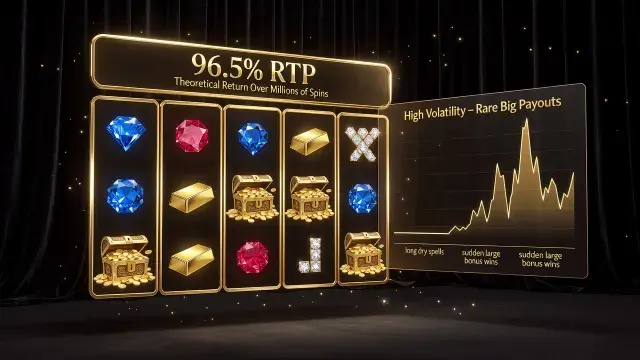
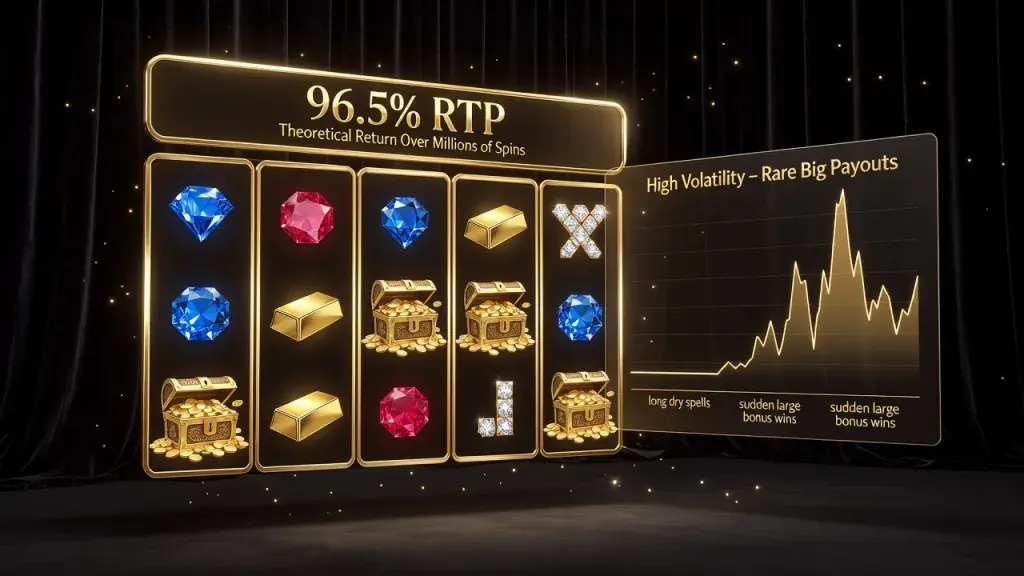
A slot machine returning 96% to players over its lifetime can still empty a wallet in twenty spins. That contradiction confuses more players than any other aspect of online slots, and it sits at the center of every conversation about gold gemstones RTP. Gem-themed slots, with their glittering payline symbols and jackpot promises, tend to attract players who assume a high advertised return rate translates into frequent wins. It rarely works that way, and understanding why requires a closer look at what RTP actually measures.
Gold and gemstone slots occupy a specific niche in casino libraries. They lean on visual richness - sapphires, rubies, gold bars, treasure chests - while running on the same mathematical engines as any other slot category. The gemstone gold slot RTP figure printed in the paytable or help screen is a theoretical average, not a promise tied to any single session. Some players discover this the hard way after checking a title like gemstones gold rtp expecting a smooth payout curve and instead hitting a long dry spell before a cluster of wins evens things out. That gap between theory and lived experience is exactly what this article addresses.
What follows is a practical breakdown of how RTP is calculated for gold and gem slots, what separates a strong gold gemstone casino RTP from a mediocre one, and how volatility interacts with return rates to shape the actual player experience.
What RTP Actually Means in Gold Gemstone Slots
Return to Player is a percentage representing the portion of all wagered money a slot is mathematically designed to pay back over millions of spins. It is not a countdown, not a guarantee, and not a per-session metric. A machine advertising 96.5% gem gold RTP will, over an enormous sample size, return $96.50 for every $100 wagered across all players combined. Individual outcomes swing wildly above and below that line.
How the Percentage Is Calculated
Developers build RTP into the game's mathematical model before launch, running simulations across billions of virtual spins to confirm the payout curve matches the target percentage. The final number accounts for every possible outcome: base game wins, bonus round triggers, free spin multipliers, and jackpot contributions. Once certified, the gold gemstones rtp figure becomes fixed and cannot be altered without regulatory approval and a new certification cycle.
Theoretical vs. Actual Return Rates
Casinos report theoretical RTP because actual RTP - what real players experienced over a given period - fluctuates constantly and is rarely published. A gemstone gold slot RTP of 97% might show an actual return of 89% over one week at a specific casino simply due to short-term variance, then swing to 103% the following week. Only over a very long horizon do the two figures converge.
Where to Find Verified RTP Data
Reliable RTP figures come from three sources: the game's own information screen, independent testing labs such as eCOGRA or iTech Labs, and licensing authority disclosures. Numbers pulled from unofficial forums or third-party blogs should be treated with skepticism unless cross-referenced against these primary sources.
Why Gold and Gem-Themed Slots Vary So Much in RTP
Not all gold gemstone casino RTP figures sit in the same range. Some titles run as low as 92%, others exceed 98%, and the gap has nothing to do with the gemstone theme itself - it comes down to studio design choices, market regulations, and monetization strategy.
Studio and Provider Differences
Different developers apply different house edges depending on their target market and business model. A provider building for high-volume mobile casinos might set a tighter RTP to protect margins on smaller average bets, while a provider targeting high-roller desktop players might offer a more generous gem gold RTP to stay competitive.
Bonus Features and Their Impact on Return Rates
Free spin rounds, wild multipliers, and gamble features all consume a share of the total RTP budget. A slot with a lavish bonus round often redistributes more of its return rate into that feature, meaning base-game spins pay less frequently but bonus triggers pay significantly more when they land.
- Free spins with multipliers: increase variance, concentrate payouts into fewer, larger wins
- Gamble/double-up features: typically neutral to RTP but raise short-term risk
- Progressive jackpot contributions: siphon a small percentage from every spin into a growing prize pool
- Bonus buy options: let players purchase entry into a feature at a fixed RTP-adjusted price
Jurisdiction and Licensing Requirements
Regulatory bodies in different regions set minimum RTP thresholds. Some markets require a minimum of 85%, others push closer to 90% or higher. A gold gemstones rtp figure that looks generous in one jurisdiction might be the legal floor in another, so comparing raw percentages across regions without checking licensing context can be misleading.
Reading and Comparing RTP Rates Across Gold Gem Slots
Once a player understands what RTP represents, the next step is comparison. Not every title with "gold" or "gem" in its name delivers the same value, and spotting the difference takes more than glancing at a single number.
Where RTP Information Is Typically Displayed
Most licensed slots disclose their RTP inside the in-game information or paytable menu, usually under a tab labeled "Game Rules" or "RTP." Reputable casino platforms also list the figure on the game's lobby page, though rounding conventions vary - a game might display "96%" while its exact certified rate is 96.08%.
Comparing RTP Against Volatility
RTP alone tells an incomplete story. Volatility - how often and how much a slot pays - shapes the actual playing experience far more than the return rate does. A high gemstone gold slot RTP paired with high volatility means rare but large wins; the same RTP paired with low volatility means frequent, small payouts. Two slots with an identical gem gold RTP can feel completely different to play.
Red Flags: When Advertised RTP Doesn't Match Play Experience
A mismatch between advertised RTP and observed play patterns over a large sample can signal an unlicensed or poorly regulated title. Warning signs include the absence of a certified testing lab logo, RTP figures that change without explanation, or a casino that refuses to disclose the number at all.
Practical Strategies for Playing Gold Gemstone Slots with RTP in Mind
RTP doesn't dictate outcomes on a single spin, but it does inform smarter long-term decisions about bankroll and game selection.
Bankroll Management Based on Volatility and RTP
Players tackling a high-volatility gold gemstone casino RTP title should allocate a larger buffer relative to their bet size, since dry stretches can run longer before a payout arrives. Low-volatility titles allow smaller buffers and steadier, more predictable session lengths.
Session Length and Its Effect on Realized Returns
Short sessions amplify variance - a 20-spin session on a 96% RTP slot might return anywhere from 40% to 250% of the wager, purely by chance. Longer sessions smooth that curve, bringing realized returns closer to the theoretical gemstones and gold slot RTP figure, though never with certainty.
Choosing Between High-RTP and High-Volatility Titles
Players chasing steady, moderate wins should prioritize RTP percentage first. Players seeking occasional large payouts should weigh volatility more heavily, even if it means accepting a slightly lower overall gold gemstones rtp figure in exchange for bigger feature-round potential.
Common Misconceptions About Gold Gem Slot RTP
Misunderstanding how RTP functions leads to poor decisions and unrealistic expectations. Clearing up the most persistent myths helps players approach these games with a more grounded mindset.
"High RTP Guarantees Frequent Wins"
RTP says nothing about win frequency - that's a function of hit frequency, a separate statistic. A slot can carry a strong gem gold RTP while paying out on only 20% of spins, because a small number of large wins offsets many losing spins mathematically.
"RTP Changes Based on Time of Day or Player Behavior"
Certified RTP is locked into the game's code and cannot shift based on the clock, the player's betting history, or how long a session has run. Any casino claiming otherwise is either misinformed or operating outside standard regulatory practice.
"All Gold-Themed Slots Share Similar RTP Ranges"
Theme has no bearing on mathematical structure. A gold-and-gemstone aesthetic is purely cosmetic; the underlying gemstone gold slot RTP is set independently by the developer and can vary as widely within the theme as it does across the entire slot market.
Frequently Asked Questions
What is a good RTP percentage for a gold gemstone slot?
Anything at or above 96% is generally considered strong for this category. Rates between 94% and 96% are average, while anything below 92% should prompt a player to check the licensing details before committing significant bankroll.
Does a higher RTP mean I will win more often?
Not necessarily. RTP measures the theoretical return over the long run, not how frequently a slot pays out. A high-RTP slot can still have low hit frequency if its payouts are concentrated in rare, large wins rather than small, frequent ones.
Can casinos change a slot's RTP after it's been certified?
No, not without resubmitting the game for testing and certification under its new configuration. Once a regulator approves a specific RTP value, that figure is locked into the game's code for as long as it runs under that certification.
Why do the same slot titles sometimes show different RTP values on different casino sites?
Some developers release multiple RTP configurations of the same game, and individual casinos can choose which version to offer within regulatory limits. Always check the specific RTP listed on the platform you're using rather than relying on figures found elsewhere.
Is volatility more important than RTP when choosing a slot?
Both matter, but for different reasons. RTP indicates long-term value, while volatility shapes the actual rhythm of wins and losses during a session - a player's risk tolerance should guide how much weight they give each factor.
Where can I verify that a gold gemstone slot's advertised RTP is accurate?
Check the game's official information screen, look for a certification mark from an independent testing lab, and confirm the casino operates under a recognized gaming license. These three checks together offer the most reliable verification.