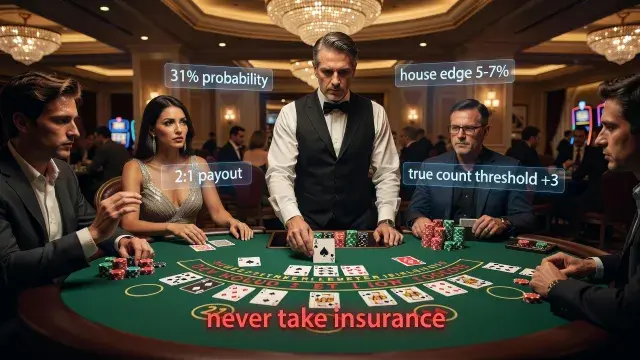
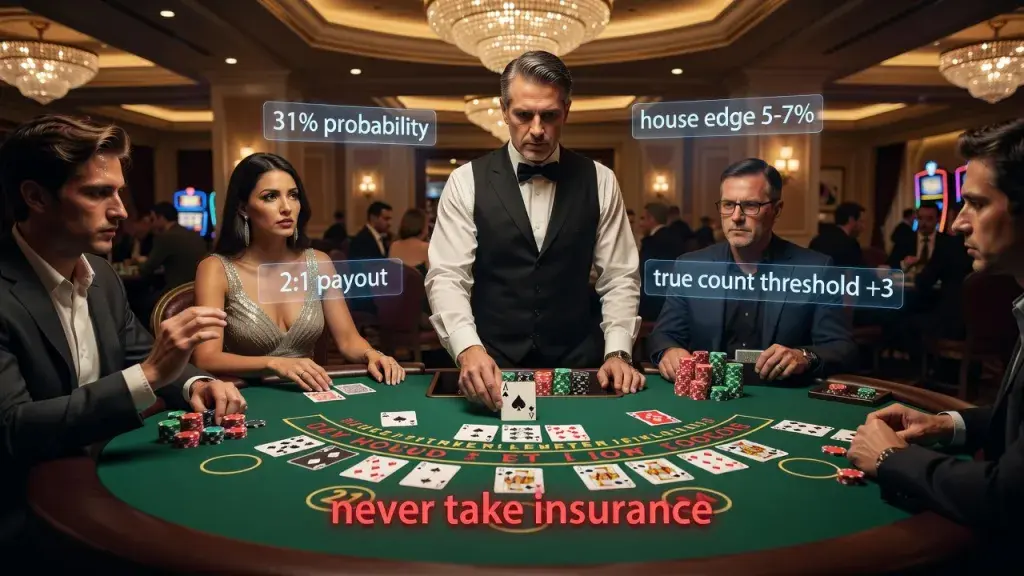
A dealer's ace hits the felt and a small voice in every player's head asks the same question: should I protect my hand? Casinos designed insurance to sound like a safety net, but the math tells a different story. Over thousands of hands, this single side bet quietly transfers more money to the house than almost any other decision at the table.
The appeal is obvious. You've got a strong hand, the dealer shows an ace, and for a small price you can guard against disaster. Dealers even prompt you with "insurance?" as if it were a courtesy. But the numbers behind that offer rarely favor you, and understanding exactly why requires a closer look at deck composition, payout structure, and the rare exceptions where the bet actually makes sense. For a deeper technical breakdown, the analysis at is blackjack insurance worth it covers the probability mechanics in detail, and it's worth cross-referencing as you build your own approach. This guide walks through the odds, the payout math, and the specific situations where taking insurance stops being a sucker bet and starts being a calculated move.
What Blackjack Insurance Actually Is
The Mechanics of the Side Bet
Insurance activates only when the dealer's up card is an ace. Before anyone acts on their hand, the dealer offers all players the chance to place a side wager worth up to half their original bet. If the dealer's hole card turns out to be a ten-value card, completing blackjack, the insurance bet pays out. If not, the insurance bet is lost, and play continues as normal with the original hand.
Why Casinos Offer It in the First Place
Casinos don't offer insurance out of generosity. It exists because the bet carries a built-in house edge that's higher than the edge on the main blackjack game itself. The framing as "insurance" makes it psychologically appealing - nobody likes the feeling of losing to a dealer blackjack after playing their hand well - but the label doesn't change the underlying probability.
How It Differs From Even Money
When a player holds a natural blackjack and the dealer shows an ace, the dealer often offers "even money" instead of standard insurance. This is functionally identical to taking insurance on a winning blackjack: you lock in a guaranteed 1:1 payout instead of risking the hand playing out normally. It's the same bet wearing a different name, and the same math applies.
Blackjack Insurance Odds Explained
The Deck Composition Math
A standard deck contains 52 cards, 16 of which are ten-value cards (tens, jacks, queens, kings). With the dealer showing an ace, there are 51 unknown cards remaining. Of those, roughly 16 are ten-value cards, assuming none are visible in your own hand or others' hands. That means the probability of the dealer holding blackjack is close to 16/51, or about 31%. The bet only wins about three times out of every ten it's placed.
Why the House Edge Is So High
Because the true odds of a ten-value hole card are roughly 31%, but the payout structure assumes a lower probability, the bet is mathematically skewed toward the house. This is the core reason blackjack insurance odds run against the player far more steeply than the main game's house edge, which in well-played basic strategy can drop below 1%. Insurance alone can carry a house edge in the range of 5% to 7%, depending on remaining card composition.
How Card Counting Changes the Calculation
Card counters track the ratio of high cards to low cards remaining in the shoe. When a disproportionate number of ten-value cards remain undealt, the probability of a dealer blackjack rises above the standard 31% threshold. This is the one scenario where the math can genuinely flip in the player's favor, and it's the foundation of any legitimate blackjack insurance strategy built around counting.
Blackjack Insurance Payout Structure
Standard 2:1 Payout Rules
Insurance pays 2:1. If you bet $10 on insurance and the dealer reveals blackjack, you receive $20 in winnings on top of your original $10 back. Combined with your main hand - which typically pushes or loses against a dealer blackjack unless you also have one - the net effect is roughly breaking even on the round when insurance hits.
Calculating Expected Value
Expected value math makes the disadvantage concrete. With roughly a 31% chance of winning 2:1 and a 69% chance of losing the bet outright, the expected return on a $10 insurance bet works out to a loss over the long run. Multiply that by thousands of hands and the losses compound steadily, even though any single bet feels harmless.
Comparing Payout to Real Probability
The 2:1 payout would be fair if the true odds were exactly 2:1 against a dealer blackjack - meaning a 33.3% chance. But the actual probability in a standard, unshuffled six-deck or eight-deck shoe hovers just under that threshold in neutral counts, and often falls further below it as the shoe depletes high cards. The blackjack insurance payout looks generous on paper, but the odds baked into a typical shoe rarely support it.
When to Take Blackjack Insurance (And When Not To)
Situations Where It's Almost Never Worth It
Under ordinary conditions - a freshly shuffled deck or early in a shoe with no significant card tracking - insurance is a losing proposition every time. Basic strategy charts developed by blackjack analysts consistently advise against it, regardless of what the player's own hand looks like. Holding a strong hand yourself doesn't change the dealer's hole card odds, a common misconception among newer players.
The Rare Case for Card Counters
When to take blackjack insurance boils down almost entirely to deck composition. Skilled counters using systems like Hi-Lo track the running count and convert it to a true count adjusted for remaining decks. When that true count signals a high concentration of ten-value cards left in the shoe, the probability of a dealer blackjack can exceed the 33.3% break-even threshold, making insurance a positive expected value bet in that specific moment.
Table Conditions That Affect the Decision
Number of decks in play matters. Single-deck and double-deck games shift probabilities more dramatically with each card dealt, giving skilled players more frequent opportunities to spot favorable insurance counts. Six- and eight-deck shoes dilute that effect substantially, making profitable insurance moments rarer and harder to detect without disciplined counting.
Blackjack Insurance Strategy for Different Player Types
Basic Strategy Players
For players relying on basic strategy without tracking cards, the rule is simple and absolute: never take insurance, and never take even money on a blackjack. The house edge on this side bet is too consistent and too unfavorable to justify occasional exceptions based on gut feeling.
Card Counters and Advantage Players
For counters, insurance becomes a precision tool rather than a blanket rule. A disciplined blackjack insurance strategy for advantage players involves setting a specific true count threshold - often around +3 in a Hi-Lo system - above which insurance becomes profitable, and refusing it below that line without exception.
Casual and Recreational Players
Recreational players who aren't counting cards but still want to engage with the game strategically should treat insurance the same way as any other unfavorable side bet: as entertainment cost, not a value play. Skipping it consistently preserves bankroll better than treating it as a coin-flip safety measure.
- Basic strategy players: decline insurance every time, no exceptions.
- Card counters: take insurance only above a calculated true count threshold.
- Casual players: treat insurance as a guaranteed long-term loss and skip it.
Is Blackjack Insurance Worth It? Final Verdict
Weighing the Math Against the Feeling
Is blackjack insurance worth it for the average player sitting at a table without a card-counting system running in their head? No. The odds are stacked against the bet clearly enough that no amount of table intuition changes the outcome over time. The temporary comfort of "protecting" a good hand doesn't offset the statistical drain.
What Separates Profitable Insurance From a Bad Habit
The difference between a savvy insurance bet and a costly habit comes down entirely to information. Players who know the composition of the remaining shoe through accurate counting can identify the narrow windows where insurance pays. Everyone else is simply gambling on a bet with worse odds than the main game they're already playing.
Frequently Asked Questions
Does taking insurance protect my original bet from losing?
No. Insurance is a completely separate wager from your main hand. If the dealer doesn't have blackjack, you lose the insurance bet regardless of how your original hand plays out, and your main bet is settled independently based on normal blackjack rules.
Should I take even money if I have a natural blackjack?
Taking even money is mathematically identical to taking insurance on that hand, and it carries the same house edge disadvantage. Unless you're counting cards and know the shoe favors ten-value cards, declining even money and letting the hand play out normally produces better long-term results.
Can insurance ever be a good bet without card counting?
Practically, no. Without tracking which cards have already been played, you're relying on the standard deck probability, which sits below the break-even point needed to make insurance profitable. Any win feels good in the moment, but the underlying odds don't support it as a repeatable strategy.
Why do dealers offer insurance so confidently if it's a bad bet for players?
Dealers offer insurance because house rules require it whenever an ace is showing, not because it benefits players. The bet generates consistent revenue for the casino precisely because most players accept it without running the probability calculation themselves.
How does the number of decks in a shoe affect insurance decisions?
Fewer decks mean each card dealt shifts the remaining ratio of high to low cards more significantly, which creates more frequent opportunities for counters to spot favorable insurance situations. In multi-deck shoes with six or eight decks, those shifts happen more gradually, making profitable insurance windows less frequent and harder to time correctly.
Is there a version of blackjack where insurance rules differ?
Some variants adjust payout ratios or introduce different side bet structures tied to the dealer's up card, but the core probability logic remains the same across most reputable versions. Always check the specific table's posted rules before assuming standard 2:1 insurance payouts apply.